Child safety education is important, yet abstract rules can be
difficult for young children to understand and remember. Parents
may also lack the time, specialized knowledge, or confidence to
provide safety instruction consistently. SafeQA investigates
whether familiar story events can become situated prompts for
discussing how a child should respond in a comparable real-life
situation.
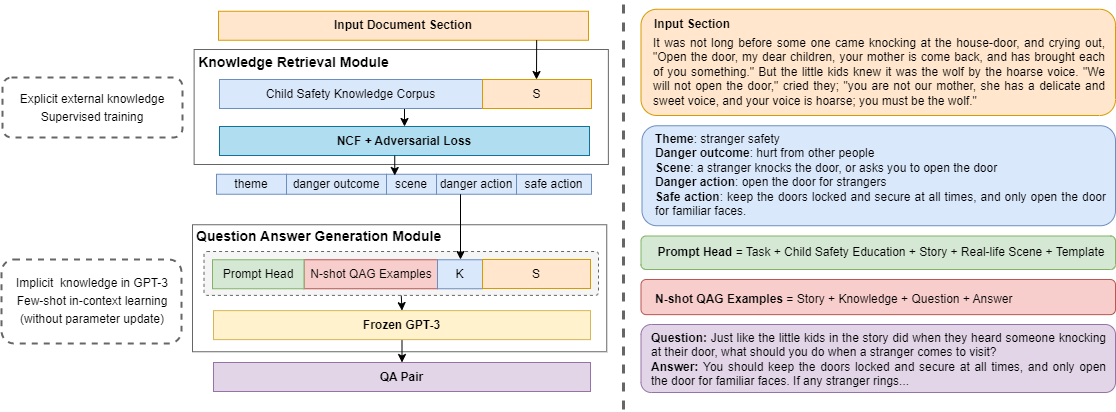
STORY MOMENTA stranger offers Snow White an apple.
→
SAFETY CONNECTIONShould you accept food from someone you do not know?
→
REAL-LIFE ACTIONRefuse politely and ask a trusted adult.
What the formative study changed
Seven parents of children aged 5-9 participated in semi-structured
interviews. The findings shaped three requirements: integrate
safety learning into recurring everyday activities; anchor
abstract guidance in simple, imaginable situations; and use an
agent to assist, rather than assume unlimited parent time or
expertise.
01Repeat in context
Safety learning should recur naturally instead of depending
only on occasional formal instruction.
02Show a situation
Concrete story scenes give children an accessible mental model
for otherwise abstract risks.
03Support caregivers
Automation can help parents surface relevant material while
preserving adult involvement.